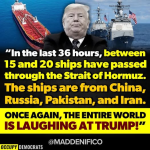
Trump Humiliated as Ships Defy U.S. Navy Blockade

wait you said we cleared things you aren't sure were there? LOL only a magat.
The Strait of Hormuz is currently contested, with both the U.S. and Iran asserting control but in different ways.

  • Iran maintains de facto control over most of the strait, having imposed a system requiring ships to coordinate with its navy, rerouting traffic through Iranian territorial waters, and demanding transit fees (up to $2 million per ship). Iran continues to threaten military action against foreign warships and claims full authority over the waterway’s security.
  • The U.S. has initiated a naval blockade targeting only Iranian ports as of April 13–14, 2026, aiming to break Iran’s hold. U.S. Navy destroyers have entered the strait to conduct mine-clearing operations and enforce freedom of navigation, asserting that vessels transiting to non-Iranian ports should not be impeded.
In practice, Iran still controls access for most commercial traffic, while the U.S. is actively challenging that control militarily. The situation remains fluid, with both sides accusing the other of ceasefire violations and no clear resolution in sight.
Strait of Hormuzstrait between the Gulf of Oman and the Persian Gulf
Wikipedia
GeographyShippingCrossing
 
The Strait of Hormuz is currently contested, with both the U.S. and Iran asserting control but in different ways.

  • Iran maintains de facto control over most of the strait, having imposed a system requiring ships to coordinate with its navy, rerouting traffic through Iranian territorial waters, and demanding transit fees (up to $2 million per ship). Iran continues to threaten military action against foreign warships and claims full authority over the waterway’s security.
  • The U.S. has initiated a naval blockade targeting only Iranian ports as of April 13–14, 2026, aiming to break Iran’s hold. U.S. Navy destroyers have entered the strait to conduct mine-clearing operations and enforce freedom of navigation, asserting that vessels transiting to non-Iranian ports should not be impeded.
In practice, Iran still controls access for most commercial traffic, while the U.S. is actively challenging that control militarily. The situation remains fluid, with both sides accusing the other of ceasefire violations and no clear resolution in sight.
Strait of Hormuzstrait between the Gulf of Oman and the Persian Gulf
Wikipedia
GeographyShippingCrossing
My information is that there is no mine clearing going on, and that the destroyers were warned that they were about to be sunk and turned around and left.
 
My information is that there is no mine clearing going on, and that the destroyers were warned that they were about to be sunk and turned around and left.
^ this is correct, according to reporting.

The US warships approached the Strait and were messaged by Iran to not enter or they would be attacked and they turned back, rather than risk it.
 
Last edited:
^ this is correct.

The US warships approached the Strait and were messaged by Iran to not enter or they would be attacked and they turned back, rather than risk it.
I have no doubt they had specific orders for the contingency. Odd since, if Trump really wanted to push this, he would have ordered them to go in.
While there would be some risk, the ships have enough defensive systems to ward off attacks while E-2 and AWACS aircraft would be watching for the launch points of missiles and drones for a counterattack.
 
Back
Top