No collusion: How Americans were fed a false tale about Donald Trump's 2016 campaign

See I knew you couldn't read!
The indictment exposes former Hillary Clinton aide Charles Dolan, identified only as “PR Executive-1,” as an important Danchenko source. Dolan allegedly fed Danchenko information he claimed he had obtained when he “had a drink with a GOP friend,” but later admitted he had fabricated the story. The indictment also shows that PR Executive-1 was an important source for reporting by The Washington Post and the Times of London when the Steele dossier scandal broke in January 2017.

The Danchenko indictment is particularly telling in detailing how the fake story was inserted into the political ecosystem, starting with Dolan and perhaps others. Danchenko allegedly fed the falsehoods to Steele, a British former intelligence operative hired by Fusion GPS to conduct the research.

Fusion GPS had been retained by Clinton campaign lawyer Marc Elias, whom law professor Johnathan Turley has called a "potential apex target” of the Durham probe. Clinton supporters in the government slipped the information to sympathetic operatives in the Justice Department, who used it to mount a spying campaign on Trump. And the American news media spread the rumors, which undermined the Trump presidency.

that is petty bullshit....what i showed was donnie trump, the trump campaign manager, and jared, his top adviser agreeing to meet with a russian who they were told had dirt on hillary sent by putin to help trump win the election...dumbfuck bitch.
 
The Mueller Report documents all the contacts between Russians and the Trump Campaign. Right wingers are too lazy to read it.

well, it is extremely difficult for them to read, if it has too many two syllable words in it. just like adding and subtraction- it is a long bridge to cross.
 
well, it is extremely difficult for them to read, if it has too many two syllable words in it. just like adding and subtraction- it is a long bridge to cross.

There are a lot of words in that report. But they refuse to even read the first two pages where he explains his findings.
 
694940094001_5620283860001_5620280173001-vs.jpg


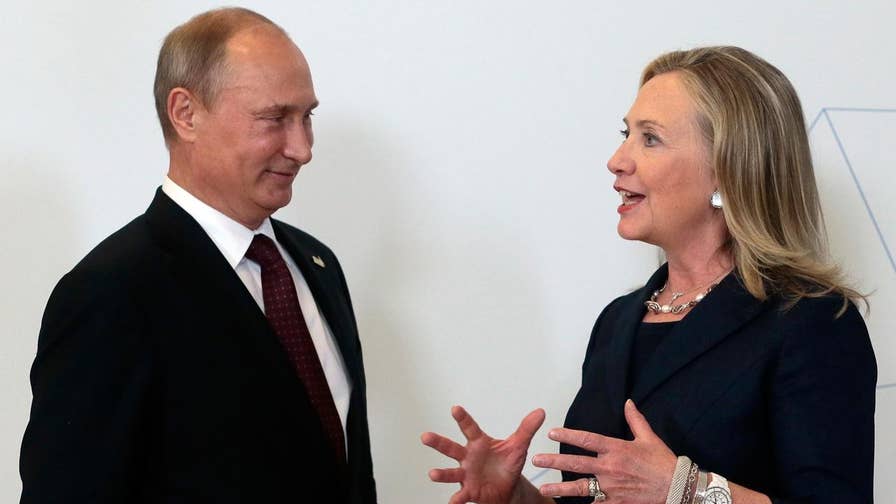
JPP LEFTISTS WISH THEY HAD SOMEONE TO LOOK @ THEM THE WAY VLAD LOOKED AT HILLARY


You may have heard of a scandal regarding uranium.

Presidential advisers cutting sweetheart deals with a foreign power, signing million dollar lobbying contracts with that foreign power, bribes being proffered, and the foreign government gained unprecedented access to government agencies and crucial U.S. natural resources?

And what if I told you that foreign power was Russia?

Collusion you say? Perhaps.

Collusion with Trump? Nope.


http://tinyurl.com/DEMS-colluded

not true, stupid fuck bitch. proves you will believe anything, like a dumbass dickhead.

The 2010 deal allowed Rosatom, the Russian nuclear energy agency, to acquire a controlling stake in Uranium One, a Canadian-based company with mining stakes in the Western United States.

We covered it during the 2016 presidential campaign, when Donald Trump falsely accused former Secretary of State Hillary Clinton of giving away U.S. uranium rights to the Russians and claimed — without evidence — that it was done in exchange for donations to the Clinton Foundation.

Now, the issue is back in the news, and numerous readers have asked us about it again. So we will recap here what we know — and don’t know — about the 2010 deal.

The Deal
On June 8, 2010, Uranium One announced it had signed an agreement that would give “not less than 51%” of the company to JSC Atomredmetzoloto, or ARMZ, the mining arm of Rosatom, the Russian nuclear energy agency.

At the time, Uranium One’s two licensed mining operations in Wyoming amounted to about “20 percent of the currently licensed uranium in-situ recovery production capacity in the U.S.,” according to the Nuclear Regulatory Commission. In-situ recovery is the extraction method currently used by 10 of the 11 licensed U.S. uranium producers.

Uranium One also has exploration projects in Arizona, Colorado and Utah.

But the deal required multiple approvals by the U.S., beginning with the Committee on Foreign Investments in the United States. Under federal law, the committee reviews foreign investments that raise potential national security concerns.

The Committee on Foreign Investments in the United States
The Committee on Foreign Investments has nine members, including the secretaries of the treasury, state, defense, homeland security, commerce and energy; the attorney general; and representatives from two White House offices (the United States Trade Representative and the Office of Science and Technology Policy).

The committee can’t actually stop a sale from going through — it can only approve a sale. The president is the only one who can stop a sale, if the committee or any one member “recommends suspension or prohibition of the transaction,” according to guidelines issued by the Treasury Department in December 2008 after the department adopted its final rule a month earlier.

For this and other reasons, we have written that Trump is wrong to claim that Clinton “gave away 20 percent of the uranium in the United States” to Russia. Clinton could have objected — as could the eight other voting members — but that objection alone wouldn’t have stopped the sale of the stake of Uranium One to Rosatom.

“Only the President has the authority to suspend or prohibit a covered transaction,” the federal guidelines say.

The Nuclear Regulatory Commission
It is also important to note that other federal approvals were needed to complete the deal, and even still more approvals would be needed to export the uranium.

First, the Nuclear Regulatory Commission had to approve the transfer of two uranium recovery licenses in Wyoming from Uranium One to the Russian company. The NRC announced it approved the transfer on Nov. 24, 2010. But, as the NRC explained at the time, “no uranium produced at either facility may be exported.”


As NRC explained in a March 2011 letter to Republican Sen. John Barrasso of Wyoming, the Russian company would have to apply for and obtain an export license and “commit to use the material only for peaceful purposes” in accordance with “the U.S.-Russia Atomic Energy Act Section 123 agreement for peaceful nuclear cooperation.”

In a June 2015 letter to Rep. Peter Visclosky, the NRC said it granted RSB Logistics Services an amendment to its export license in 2012 to allow the Kentucky shipping company to export uranium to Canada from various sources — including from a Uranium One site in Wyoming. The NRC said that the export license allowed RSB to ship uranium to a conversion plant in Canada and then back to the United States for further processing.

Canada must obtain U.S. approval to transfer any U.S. uranium to any country other than the United States, the letter says.

“Please be assured that no Uranium One, Inc.-produced uranium has been shipped directly to Russia and the U.S. Government has not authorized any country to re-transfer U.S. uranium to Russia,” the 2015 letter said.

“That 2015 statement remains true today,” David McIntyre, a spokesman for the NRC, told us in an email.


RSB Logistics’ current export license, which expires in December, still lists Uranium One as one of its suppliers of uranium.

Uranium One, which is now wholly-owned subsidiary of Rosatom, sells uranium to civilian power reactors in the United States, according to the Energy Information Administration. But U.S. owners and operators of commercial nuclear reactors purchase the vast majority of their uranium from foreign sources. Only 11 percent of the 50.6 million pounds purchased in 2016 came from U.S. domestic producers, according to the EIA.

Although Uranium One once held 20 percent of licensed uranium in-situ recovery production capacity in the U.S., that’s no longer the case. There were only four in-situ recovery facilities licensed by the NRC in 2010. Currently, there are 10 such facilities, so Uranium One’s mining operations now account for an estimated 10 percent of in-situ recovery production capacity in the U.S., the NRC told us in an email.

As for production, the company was responsible for only about 11 percent of U.S. uranium production in 2014, according to 2015 congressional testimony by a Department of Energy contractor. More recently, Uranium One has been responsible for no more than 5.9 percent of domestic production, according to a September 2017 report by the U.S. International Trade Commission

https://www.factcheck.org/2017/10/facts-uranium-one/
 
Trump tried to get Mueller fired and threatened his own staff when they refused to do it.


Mueller tried to "get Trump", and that just didn't happen.

Millions of taxpayer dollars wasted on the bullshit.

It was wrong when they did it to Bubba, too. About all of those sham impeachments; I say Congress should not get paid for those days. But oops! They already have been. :(
 
not true, stupid fuck bitch. proves you will believe anything, like a dumbass dickhead.

The 2010 deal allowed Rosatom, the Russian nuclear energy agency, to acquire a controlling stake in Uranium One, a Canadian-based company with mining stakes in the Western United States.

We covered it during the 2016 presidential campaign, when Donald Trump falsely accused former Secretary of State Hillary Clinton of giving away U.S. uranium rights to the Russians and claimed — without evidence — that it was done in exchange for donations to the Clinton Foundation.

Now, the issue is back in the news, and numerous readers have asked us about it again. So we will recap here what we know — and don’t know — about the 2010 deal.

The Deal
On June 8, 2010, Uranium One announced it had signed an agreement that would give “not less than 51%” of the company to JSC Atomredmetzoloto, or ARMZ, the mining arm of Rosatom, the Russian nuclear energy agency.

At the time, Uranium One’s two licensed mining operations in Wyoming amounted to about “20 percent of the currently licensed uranium in-situ recovery production capacity in the U.S.,” according to the Nuclear Regulatory Commission. In-situ recovery is the extraction method currently used by 10 of the 11 licensed U.S. uranium producers.

Uranium One also has exploration projects in Arizona, Colorado and Utah.

But the deal required multiple approvals by the U.S., beginning with the Committee on Foreign Investments in the United States. Under federal law, the committee reviews foreign investments that raise potential national security concerns.

The Committee on Foreign Investments in the United States
The Committee on Foreign Investments has nine members, including the secretaries of the treasury, state, defense, homeland security, commerce and energy; the attorney general; and representatives from two White House offices (the United States Trade Representative and the Office of Science and Technology Policy).

The committee can’t actually stop a sale from going through — it can only approve a sale. The president is the only one who can stop a sale, if the committee or any one member “recommends suspension or prohibition of the transaction,” according to guidelines issued by the Treasury Department in December 2008 after the department adopted its final rule a month earlier.

For this and other reasons, we have written that Trump is wrong to claim that Clinton “gave away 20 percent of the uranium in the United States” to Russia. Clinton could have objected — as could the eight other voting members — but that objection alone wouldn’t have stopped the sale of the stake of Uranium One to Rosatom.

“Only the President has the authority to suspend or prohibit a covered transaction,” the federal guidelines say.

The Nuclear Regulatory Commission
It is also important to note that other federal approvals were needed to complete the deal, and even still more approvals would be needed to export the uranium.

First, the Nuclear Regulatory Commission had to approve the transfer of two uranium recovery licenses in Wyoming from Uranium One to the Russian company. The NRC announced it approved the transfer on Nov. 24, 2010. But, as the NRC explained at the time, “no uranium produced at either facility may be exported.”


As NRC explained in a March 2011 letter to Republican Sen. John Barrasso of Wyoming, the Russian company would have to apply for and obtain an export license and “commit to use the material only for peaceful purposes” in accordance with “the U.S.-Russia Atomic Energy Act Section 123 agreement for peaceful nuclear cooperation.”

In a June 2015 letter to Rep. Peter Visclosky, the NRC said it granted RSB Logistics Services an amendment to its export license in 2012 to allow the Kentucky shipping company to export uranium to Canada from various sources — including from a Uranium One site in Wyoming. The NRC said that the export license allowed RSB to ship uranium to a conversion plant in Canada and then back to the United States for further processing.

Canada must obtain U.S. approval to transfer any U.S. uranium to any country other than the United States, the letter says.

“Please be assured that no Uranium One, Inc.-produced uranium has been shipped directly to Russia and the U.S. Government has not authorized any country to re-transfer U.S. uranium to Russia,” the 2015 letter said.

“That 2015 statement remains true today,” David McIntyre, a spokesman for the NRC, told us in an email.


RSB Logistics’ current export license, which expires in December, still lists Uranium One as one of its suppliers of uranium.

Uranium One, which is now wholly-owned subsidiary of Rosatom, sells uranium to civilian power reactors in the United States, according to the Energy Information Administration. But U.S. owners and operators of commercial nuclear reactors purchase the vast majority of their uranium from foreign sources. Only 11 percent of the 50.6 million pounds purchased in 2016 came from U.S. domestic producers, according to the EIA.

Although Uranium One once held 20 percent of licensed uranium in-situ recovery production capacity in the U.S., that’s no longer the case. There were only four in-situ recovery facilities licensed by the NRC in 2010. Currently, there are 10 such facilities, so Uranium One’s mining operations now account for an estimated 10 percent of in-situ recovery production capacity in the U.S., the NRC told us in an email.

As for production, the company was responsible for only about 11 percent of U.S. uranium production in 2014, according to 2015 congressional testimony by a Department of Energy contractor. More recently, Uranium One has been responsible for no more than 5.9 percent of domestic production, according to a September 2017 report by the U.S. International Trade Commission

https://www.factcheck.org/2017/10/facts-uranium-one/


20% controlling stake, and people that should not have signed off on it did, because Hillary might make them have an "accident" if they didn't comply.
 
Back
Top